Oxford Street Closure: 1.9km Pedestrian Zone Opens
London has banned vehicles from half its main shopping street ahead of the holidays, diverting buses and drawing mixed reactions from locals.
By Aisha Khan ·
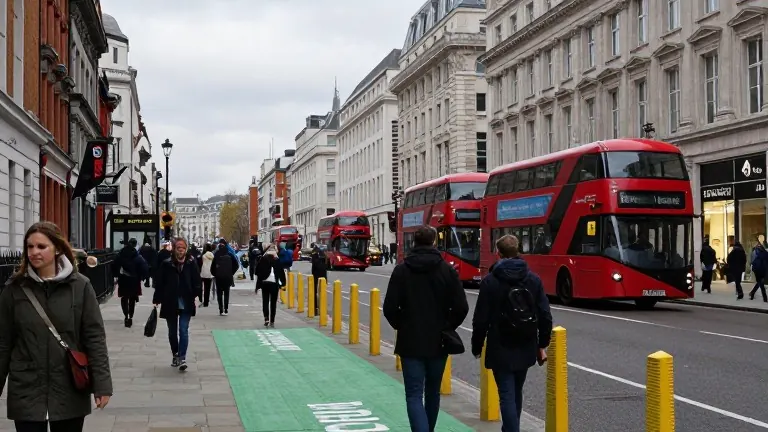
Sadiq Khan opened a 1.9-kilometer pedestrian zone on Oxford Street on Monday morning. The closure removes cars, buses, bikes, e-scooters, and taxis from the road. The area covers roughly half the street, stretching from Oxford Circus station to Marble Arch. This is the first phase of a larger project that began after years of debate.
The closure took effect in time for the Christmas shopping season. Khan described the moment as a "momentous day" in a speech at John Lewis. He noted that his first jobs were in retail on this specific street. Khan said pedestrianization with better public transport links and greenery would improve the experience for everyone. He aims to use this as a proof of concept to show that investing in people rather than traffic leads to higher footfall and spending.
Shoppers responded positively to the change. Daniel Te, who moved to London from the US in July, sketched the crowd on the street. He said the area felt like an entirely new place. Te noted that he usually avoided the street because it was too busy. He now finds it more inviting because there is extra space to walk and browse. He called the pedestrianization a big achievement and suggested neighboring streets should follow suit.
Raquel Cox, a visitor from Ireland, said she came to the street after seeing news reports. She acknowledged that surrounding roads might get busier. However, she stated that it is a better experience as a shopper. Abbas Shigival, who runs a souvenir kiosk, said the morning was slightly busier than usual. He described the environment as more pleasant because people are happier walking around.
Not everyone agreed with the decision. Ben McMullan, a taxi driver, said traffic was definitely worse on surrounding streets. He pointed out that accessibility is a major problem for customers. McMullan dropped off a mother with a pram and a woman with walking difficulties who could not get close to their destinations. He feared people would stop using cabs if they cannot reach specific locations directly. Jack, a cyclist on his way home from a construction job, was stopped by security guards. He said he would ride down the road whether officials liked it or not. He argued that the change makes commuting harder for vehicle users.
Transport for London chief operating officer Claire Mann said there is plenty of capacity for passengers. She stated that bus reliability should not be affected. Many double-decker buses are being diverted to neighboring roads. Mann noted that Bond Street and the Elizabeth Line provide alternative ways to arrive in the area. TFL will monitor ridership to check for any negative impacts.
The current setup uses temporary bollards and green welcome banners. A permanent £150 million project will begin in spring 2027. That phase includes trees, seating, and level plazas for events. Khan said London is closely monitoring these changes to ensure they work for everyone. The initial phase relies on feedback to determine the next steps for the street.
Source: The Guardian