Eisenkot Leads in Israel's Stalled Election, Facing a 61-Seat Gap
The center-right challenger has more recommended votes than Netanyahu, but his bloc lacks the parliamentary majority required to govern.
By Aisha Khan ·
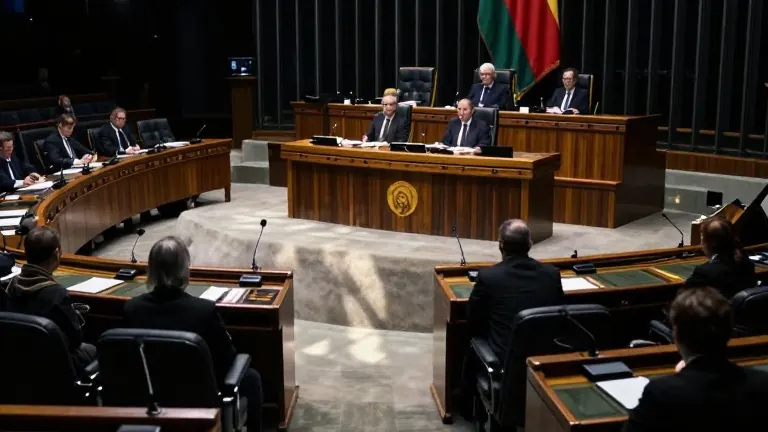
Gadi Eisenkot has the first shot at forming a government in Israel, though he faces a steep mathematical hurdle that his rival, Benjamin Netanyahu, also cannot clear. The final tally from the recent election gave opposition parties a slight edge over Netanyahu’s right-wing bloc, but neither side controls the 61 seats needed for a majority in the 120-seat Knesset.
The election results leave the country in a state of flux. Eisenkot, a former military chief of staff, leads in the recommendations from lawmakers, but his coalition is short of the necessary votes without the support of predominantly Arab parties. His team ruled out that partnership during the campaign, creating a gap of roughly 13 seats that he must fill to govern.
Netanyahu’s Likud party won the most individual votes, yet his traditional allies in the right-wing and ultra-Orthodox camps do not add up to a working majority. His bloc is missing about eight seats. This leaves both major candidates unable to form a government on their own and forces them to rely on cross-party negotiations or external shifts in power.
In the coming days, the Israeli president will speak with the leaders of every elected party. The president will select the candidate deemed most likely to assemble a coalition, a choice that is not automatically tied to the largest party. The chosen leader then has 28 days to secure the support of 61 lawmakers. The president can extend that deadline by up to 14 days if the initial effort fails.
Several paths exist for breaking the stalemate. One option is a unity government combining the parties of Eisenkot and Netanyahu. Media reports indicate President Trump favors this outcome, though it has not been independently confirmed. Such a government would likely include moderate center-right parties, potentially easing cooperation with the U.S. on Gaza reconstruction and Saudi normalization.
Eisenkot has previously pledged not to serve under a Netanyahu-led cabinet. A unity deal would require them to settle who serves as prime minister and whether the role rotates. Another possibility is an Eisenkot government backed from the outside by Arab parties. Together, they hold more than 67 seats, a comfortable majority, but Eisenkot has repeatedly rejected this arrangement due to differences on the war in Gaza.
If negotiations fail, Israel could face a fourth election. The president has urged leaders to avoid a repeat vote, noting the high turnout of the current election. However, Netanyahu may view a new election as favorable if Arab turnout drops. Liberal voters who traveled from abroad to vote in this cycle may also be less likely to return, potentially shifting the balance of power.
A third option involves defections. Netanyahu would need to persuade about eight lawmakers from opposing parties to join his side. Eisenkot would need roughly 13 defectors if he continues to exclude Arab parties, a scenario that appears unlikely given current polling and party dynamics.
The opposition can also use the Knesset to pressure Netanyahu during the interim. Eisenkot’s bloc is considering replacing the speaker of the house to control the legislative agenda. They also aim to pass a law creating a state commission of inquiry into the failures that preceded the October 7, 2023, attack. Additionally, they plan to reverse recent legislation that critics say weakened judicial independence.
The threat of renewed war with Iran adds another layer of complexity. Netanyahu stated in his election night speech that Israel must finish its mission against Iran. Eisenkot warned against using national security for political gain. Analyst Danny Citrinowicz noted that Netanyahu has an incentive to restart fighting while coalition talks are underway, as an emergency would increase pressure on Eisenkot to form a unity government.
Source: WWNO