Halloween Night Clashes Mark Third Weekend of French Student Unrest
Police deployed 70,000 officers to manage a drop in attendance, while youth-led marches in Germany and Portugal continued to target housing and education costs.
By Henry Wilson ·
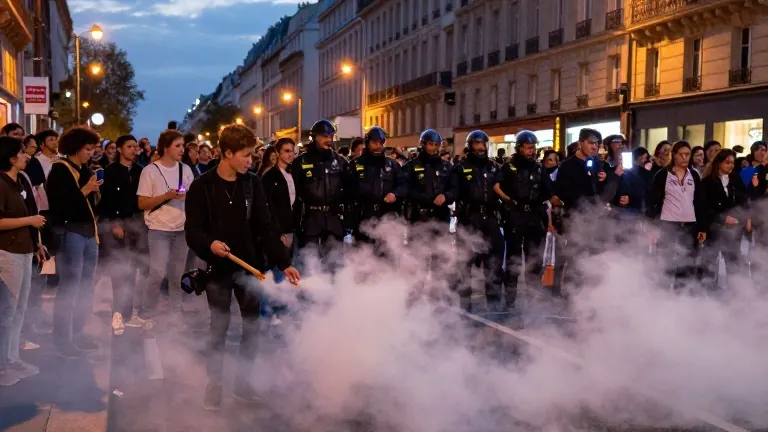
Police in France used stun grenades and tear gas against demonstrators near the end of a major march in Paris on Saturday, ending a third consecutive weekend of youth-led protests. The clashes occurred as the sun set over the city, marking a sharp turn for a march that had remained largely peaceful for hours. Authorities deployed 70,000 police and gendarmes nationwide to manage the crowds, which were rerouted to the outer edges of the capital to keep marchers away from government buildings and tourist sites.
The French government estimated that 320,000 people participated in the demonstrations on October 31. This figure is lower than the 500,000 estimated for the October 17 riots and the 410,000 counted on October 24. Interior Minister Laurent Nuñez warned of a "very high risk" of disorder, particularly after dark, following the heavy looting and rioting that marred the previous two weekends. Nationwide arrests reached approximately 300 by the end of the day, a decrease from the 800 arrests recorded at the same stage of the prior week's protests.
In Paris, 70,000 protesters gathered for the main march, which began at Porte de Bagnolet. Students led the group hand in hand, while security agents from the CGT labor union monitored the front of the crowd. The atmosphere along the Boulevards des Maréchaux was festive, with techno music playing and some marchers engaging in trick-or-treating. However, the tone shifted near Porte de Charenton, where protesters threw glass bottles and fireworks at officers. Police responded with volleys of stun grenades and tear gas, filling the streets with smoke and forcing many peaceful participants to retreat into the nearby Bois de Vincennes park.
The movement began last month as high school students protested neglected buildings and teacher shortages. Labor unions and groups angry at President Emmanuel Macron's cost-of-living policies joined the effort. Macron stated that the marches were moved out of city centers to protect local shops. Police enforced a curfew barring people from entering Place de la Republique and Les Halles between 11 p.m. and 6 a.m. on Saturday and Sunday. Unaccompanied minors faced a separate 9 p.m. curfew near the Champs-Elysees after a court suspended an earlier ban as an illegal infringement on freedom of movement.
Similar youth-led demonstrations occurred across Europe. In Germany, the "Gen Z regelt" initiative held rallies in more than 30 cities, with organizers claiming tens of thousands participated. In Berlin, students gathered at Brandenburg Gate to demand more investment in education and housing. In Cologne, police ended a march early after protesters threw stones and used pyrotechnics. In Hamburg and Frankfurt, police used water cannons and tear gas to disperse crowds that threw projectiles at officers.
In Lisbon, Portugal, thousands of families and children marched downtown to protest the housing crisis. Participants held placards reading "Houses or Fire" and carried small cardboard houses. In The Hague, Netherlands, a heavy police presence guarded the downtown shopping area following online calls for protest. While some groups of young people were frisked and stores were boarded up, local media reported that no major disturbances had occurred by midafternoon.
Source: NPR