Tampa Bay voters face redistricting, governor race on Election Day
Polls in Hillsborough and Pinellas counties open at 7 a.m. for a ballot that includes a special Senate race, a gubernatorial contest, and newly drawn House districts.
By Aisha Khan ·
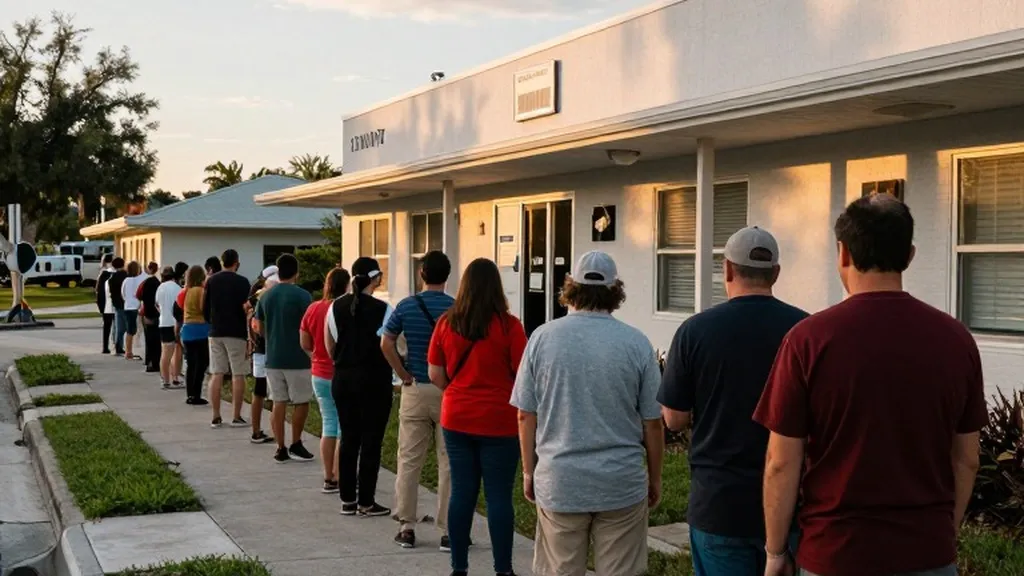
Voters across Hillsborough and Pinellas counties opened their polls at 7 a.m. Tuesday, Nov. 3, 2026, to cast ballots in a high-stakes midterm election. Polls in the region remain open until 7 p.m., with the caveat that Florida is divided between the Eastern and Central time zones, so residents should verify their specific local closing times, according to Ballotpedia. The ballot for residents in Tampa, St. Petersburg, and Pinellas Park features a mix of federal, state, and local offices, along with measures that vary by county.
The most prominent statewide item is the race for governor, which is an open seat with no incumbent running. Candidates from the Democratic, Libertarian, No Party Affiliation, and Republican parties are on the ballot, according to Ballotpedia. Additionally, Florida voters are deciding on a special election for the U.S. Senate to fill the remainder of the term originally held by Marco Rubio. Ashley B. Moody, the Republican incumbent in that special race, is on the ballot alongside Democratic and No Party Affiliation challengers.
Every U.S. House seat in the state is also up for election, reflecting a significant shift in the political landscape due to mid-decade redistricting. In Florida, Republicans redrew boundaries for four House seats hoping to gain an advantage, but early results suggest the strategy may not have succeeded. Democratic Rep. Jared Moskowitz won reelection in Florida's 25th Congressional District, a seat that was redrawn to favor Republicans, according to the Associated Press. He cited voter anger over the redistricting process and concerns about the economy as key factors in his victory.
Other Democratic candidates also held or gained seats in the state. Rep. Kathy Castor won reelection in a district where about two-thirds of voting-age residents were new following the redistricting, and Democrat Pia Dandiya won an open seat in southern Florida that Republicans had reshaped for a GOP advantage, according to the Associated Press. These results indicate that the presumed Republican support in the new maps was undercut by shifting voter opinions and dissatisfaction with the current administration.
Nationally, the election results point to a sweeping Democratic victory. As of early Wednesday, Democrats had won 20 of the 35 U.S. Senate races, with two remaining uncalled, according to Ballotpedia. This would give Democrats a net gain of seven seats, securing control of the chamber. In the U.S. House, Democrats had won 228 seats while Republicans held 138, with 69 races still uncalled, according to Ballotpedia. This trajectory suggests Democrats will take control of the House as well, ending the Republican majority.
The Associated Press reports that voters rejected the president's party across the country, driven by dissatisfaction with the economy and the war in Iran. About 6 in 10 voters said the U.S. made the wrong decision in taking military action against Iran, according to the AP Voter Poll. This sentiment contributed to a Democratic surge that swept Republicans out of power in many areas, including states that were previously considered safe Republican territory.
President Donald Trump, who was not on the ballot, has begun to lay the groundwork for blaming his party's candidates for the losses. He told reporters that if he were on the ballot, he would have won, and he emphasized his focus on the construction of a new White House ballroom rather than the election results, according to the Associated Press. Vice President JD Vance, meanwhile, publicly broke from Trump's defense of the Iran war, blaming the conflict for the Republican Party's defeat in a lengthy social media post.
For local residents, the election also included ballots for state legislative chambers, school boards, municipal government, and various ballot measures. In Florida, voters considered three constitutional amendments, including one to increase the budget stabilization fund and another to exempt agricultural property from taxes, according to Ballotpedia. Local races for mayors and other municipal offices are also part of the count, with results expected to come in after the federal and state races are called.
The outcome of these elections sets the stage for a divided government, where Congress is poised to challenge the president's agenda. House Democratic Leader Hakeem Jeffries, who is expected to become the first Black speaker of the House, promised a 100-day agenda focused on lowering the costs of gas and groceries, according to the Associated Press. Democrats also signaled a robust oversight agenda, with some members warning of potential investigations into the president and his Cabinet.
In the coming weeks, the full extent of the Democratic gains will be finalized as the remaining uncalled races are resolved. The Associated Press notes that the shift in Hispanic voting, with about one-third of Hispanics backing Republican House candidates compared to roughly 4 in 10 who voted for Trump two years ago, played a role in the results. This demographic shift, along with widespread dissatisfaction with the cost of living, defined the electorate's mood on Tuesday.
As the night wore on, the focus in Washington turned to the practical implications of the new congressional majority. The Associated Press reports that Democrats will hold at least 54 seats in the Senate and a majority well past the 218 needed in the House. This control allows them to advance legislation on healthcare and economic relief, while also providing a check on the executive branch. For Tampa Bay voters, the election was a referendum on national leadership and a local decision on who will represent their communities in the new Congress.